
Along with every other public service, funding for schools is being cut. Again.
With senior schools there’s another factor at work. Most senior schools aren’t actually public services. They’re privately owned and operated companies (operating as special forms of charities) that just happen to be funded by the government. So what happens when the money supply is throttled?
Down and to the right
We’re about to find out because the real-terms funding for academies – those privately owned schools – is about take a serious downturn. The website schoolcuts.org.uk is a pretty but terrifying resource which specialises in graphs that go down and to the right. Here’s one for South Gloucestershire.
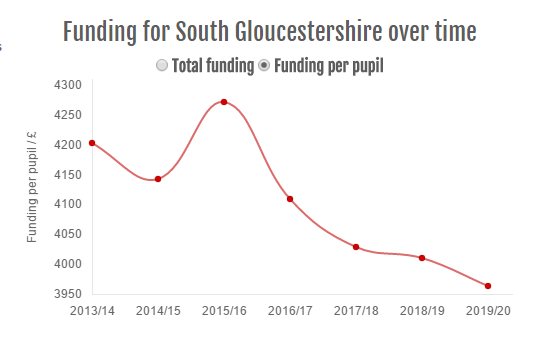
It goes up a bit to start with because the current school funding formula is changing to South Gloucestershire’s benefit. The graphs for some areas look like a nightmare big dipper.
Even the most casual observer will note that it goes down. They would also note that the y-axis isn’t zero based: this is not is an annihilation. This is a marginal drop but it’s quite a thick margin (6% over about five years) and it applies to already stretched school budgets.
For some schools it will result in an increase in class sizes, a reduction in equipment, shabbier buildings, fewer trips, and a less enriched curriculum. For other it might mean the end of the company which runs them: they will fail and may eventually close.
Avoiding the blame
In the days when local authorities ran schools a marked decline in education standards would be pinned squarely on them. It might have been precipitated at the local level or at the national level but responsibility would be in the hands of the government.
This is not so today. School funding for academies is controlled by central government but responsibility has been outsourced to private companies, to academy trusts.
When a school still under LEA control begins to fail, government policy is to transform it into an academy – to privatise it. When an academy, already private, begins to fail, and many will fail with budget cuts like these, what happens? They can’t be returned to LEA control, that’s both politically anathema and legally intractable. Instead they are taken over by other, larger academies. In fact by chains of academies, MATs: Multi Academy Trusts.
Big is bountiful
There are several reasons that MATs seem to be able to run schools that don’t fail when smaller trusts can’t.
Some people will say that it’s the power of the market ensuring only academies run in the best, most efficient manner that survive. Alternatively it might be that large academy chains have become adept at providing a Sports Direct education: cheap, bleak and based on driving down quality in favour of price.
In either case it’s clear that the trick can only be pulled off at scale. This fact is not lost on Lord Nash, the national schools commissioner, who favours large MATs at every opportunity. Under the current government, this is the future.
After consolidation
Looking a few years into the future who’s going to own the schools?
It’s likely to be a handful of large trusts in mutually beneficial co-existence plus a splattering of tiny players at the margins. Like energy suppliers, like telecoms companies: a classic comfortable capitalist stalemate, an oligopoly.
As the government continues to push down budgets what will happen? The government won’t be to blame because the cuts are enacted, at the point of delivery, by a few private companies. These private companies will be blamed but they won’t suffer because there will be no alternative. This is the same reason poor train companies don’t really suffer from their unpopularity.
Being hated is something big companies are pretty good at and so long as consumers have no power, it’s no problem.
That is mission achieved for the government: privatisation leading to power without responsibility. There’s one more step though.
Follow the money
Whilst MATs own the schools who is owning the MATs? Unsurprisingly there’s a big overlap with the people making sure this happens. Lord Nash, for example, has an interest in one of the largest chains even now.
And there there are the managers already working the field. There’s a close knit group of MAT CEOs, regional schools commissioners and advisors who collectively push the MAT agenda. And their reward is inflated salaries: academy chiefs on £200K+.
Government and NGO figures pushing policy which benefits themselves via a tax-funded company? That’s not as surprising as it should be.

 Inopportune thoughts