
The CEO of a small chain of academies in South Gloucestershire recently wrote to parents to explain the parlous state of funding at his schools. His warning signposts the way that the governments’ programme of forced austerity will dismantle the state-provided free-to-all education system. This is calamitous not only for current pupils but to all who have a stake in the future of this country – for everyone.
 That CEO, Dave Baker, made it plain that upcoming budget cuts will have a significant material effect on the education his schools are able to provide. In his letter he suggests that class sizes might grow, the number of teachers might be reduced and the school day might even be shortened. It would be easy to dismiss this as scaremongering, maybe political maneuvering, but one only has to look at other public services, such as the NHS, to see that the government is willing and empowered to risk worst-case scenarios in pursuit of their ideological aims.
Eye-catchingly Baker posits the idea of asking parents to make a financial contribution. Whilst this particular point sounds like it would be the beginning of the end of free education, it isn’t. That happened some time ago.
About South Gloucestershire
Academies, which is what almost all secondary schools in South Gloucestershire are, are privately run organisations but receive their money from central government via the Education Funding Agency. Money is allocated to schools on a per-pupil basis but the amount for each pupil varies across the country based on a “funding formula”. Broadly speaking more affluent areas receive less money per pupil or, looking at it from the other side, deprived areas, or areas with higher unavoidable costs, benefit from more money per pupil. It’s hard to describe this as intrinsically unfair.
As a relatively well-off area South Gloucestershire is already one of the worst funded areas of the country. It has, in fact, been in the bottom few nationally for years. There are long-awaited changes to make the funding formula fairer not only from parents but from education authorities.
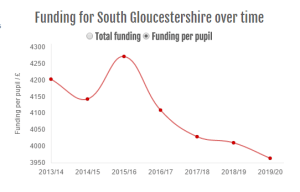 However, for every winner there’s a loser. Or, more accurately, there are only losers because the total amount of money that can be effectively spent on education per-pupil is going down everywhere. Overall there will be a £3 billion cut to education funding by 2020. The scale of the cuts mean that even those areas that do well from a fairer funding formula will be worse off. It’s clear to see on this graph how the expected fairer formula would be simply a brief respite before an ongoing decline.
The government made some manifesto pledges to maintain the level of funding going into the education system and they continue to contend that not all of these have been broken. In the real world, schools have been given additional financial responsibilities to meet and have unavoidable increasing costs (staff pensions, for example). Announcements of spending within education are largely not of new money, but money being diverted from where it’s needed into pet projects such as free schools and grammar schools.
Whilst an argument can be made that education in very deprived areas costs more to deliver – more staff may be needed to deal with challenging behaviour, and more resources needed to lift pupil from a low starting point to an acceptable level of attainment – there is a base level of funding needed to supply a decent education. Staff must be paid, buildings heated and maintained, equipment kept up to date. These costs are not necessarily significantly lower in affluent areas.
In South Gloucestershire over the next few years we’re going to find out what happens when government cuts take schools’ incomes below this level. We will also see what parents are willing to do to mitigate the effects. As a relatively well-off area South Gloucestershire will illustrate the possibilities and what it means for under-funded education nationally.
The effect
Looking more closely at Dave Baker’s list of “unthinkable” consequence to budget cuts, they fit into three categories.
First, a reduction in the quality of teaching and support in the school: using less well qualified (and lower paid) staff; a reduction in lesson planning time; a contraction in education support.
Secondly, cut-backs in the quantity of teacher time: increasing class sizes; decreasing the number of teachers; restricting the breadth of the curriculum; shorter school days.
Thirdly, paring back of extras: less extra-curricular activity; more charges for activities; lower spending on equipment.
Together these three areas represent almost everything a school does. There is no part of the education of children that will not be affected. This isn’t a dire prediction for the next decade, this is happening now. In the absence of a sudden about-face by the government some of these measures will be enacted within the next few months. The question is only which will be done first but we know the process of staff redundancies is starting right now.
We are about to see a general contraction of state-provided education: less time at school, fewer subjects taught, fewer teachers to do it. The state will cease to be a comprehensive provider of education for the vast majority. Instead it will become a supplier of the baseline, it’s provision a definition of the least possible allowed.
To be clear this is not a reflection of teachers’ lack of dedication. It is not indicative of MAT CEOs increasing their own salaries at the expense of pupils. It is a consequence of the long term policy aims of the Conservative government.
The reaction
Areas such as South Gloucestershire, particularly the more affluent areas around historically high-achieving schools tend to have more ‘involved’ parents. This is to say, parents more willing and more able to participate actively in their childrens’ educations. Previously this might have manifest only as high attendances at parents’ evenings and a vigourous PTA. Faced with a level of service cut that can’t be addressed by an extra school fate we will see this activism redirected into compensating for the loss more immediately.
Whilst the changes in South Gloucestershire represent a sea-change in education provision it is possible to look around and see which preexisting trends will accelerate.
Private tutoring
According to an Ipsos MORI poll for the Sutton Trust shows that 24% of all young people in 2013 said they had received private or home tuition at some stage in their school career, compared with 18% in 2005 and 23% in 2012.
Sir Peter Lampl, chairman of the Sutton Trust commented: “Private tuition is booming, particularly in London, despite the fact that many families have been forced to tighten their belts over recent years.” Unlike the government parents realise that education is the most sure way to invest for the future and will strive to maintain standards even as their ability to do so is challenged.
Tuition franchise holder Tutor Doctor promotes itself by saying “Private tuition in the UK is growing, with the industry worth £6.5 billion per year.” It quickly cuts to the key driver of demand: “Over 170,000 British school students are attending secondary schools deemed inadequate by Ofsted. So parents are increasingly turning to private tutoring to supplement their children’s education.” They claim “the number of students who receive tutoring in increasing from 1.6 million in 2001 to 2.8 million in 2014.”
Tutor Doctor goes on to state that most “consultations close with an average enrollment value of £1,600″ and that”there is a 55% profit margin.”, revealing where the money withdrawn from public education is actually going.
Paid after-school clubs for sport and academic pursuits
A report in the Scottish Herald quotes Mr McIlroy, a visiting professor of education at Strathclyde University, as saying: “There is a lot of evidence that enrichment activities outside school have increased over the past twenty years and middle class parents have become much more active in this area”. He goes on to warn that this “widens the attainment gap.”
A survey and analysis carried by Maths Doctors looked into the cost of both tuition and group-base after school clubs. Their main focus was on the surprisingly high cost, especially in London, but also noted that “spending on […] after school activities is turning into an entry level cost for parents”. This is to say increased provision and usage has become the norm for those who can afford it.
Research funded by the Nuffield Foundation reported in the Guardian found that “sports clubs were positively associated with attainment outcomes at age 11, even when accounting for prior attainment at age seven. For children from economically disadvantaged backgrounds, who have lower takeup of formal out-of-school activities, school-based clubs appear to offer an affordable and inclusive means of supporting academic attainment.” It is these school-base clubs which are currently being endangered.
A market report by IBIS found that “an increasing number of children aged 12 and under and government schemes to support parents’ ability to pay for childcare also contributed positively” to the economic growth of out-of-school childcare. “As a result,” they say, “revenue is projected to increase at a compound annual rate of 3.8% over the five years through 2016-17.”
The overall picture is clear: changing work patterns and accepted norms in the UK are changing; after-school clubs are becoming more entrenched. This offers a variety of benefits to the children attending (even more so as state education contracts) but it is available only when affordable. A reduction is school-provided activity will broaden the attainment gap.
Private SEN diagnoses
Children are considered as having special education needs (SEN) for a whole variety of reasons and this is a consummately wide variety of responses from the education system.
One of the most immediately apparent responses is that resources can be made available in the classroom and extra time and help can be made available in examinations. Thus there is a need for children with a definite need to receive the SEN assistance that they require. There is also pressure for children who could qualify for SEN assistance, but perhaps have a less pressing need, to receive it in order to enhance their academic outcomes.
The line between these two groups is blurred and impossible to effectively define. The fact that there is a line at all is illustrated by the difference between SEN diagnoses in state schools and that in private schools.
Radio 4’s Today programme revealed that “extra time was given to more than 27,000 independent school students in last year’s GCSE and A-level exams – nearly 20% of all pupils in the sector. In contrast, in the state sector, fewer than 12% of students (200,000) received extra time.”
So it is already the case that parents with the ability to pay achieve otherwise unobtainable outcomes for their children. As state schools retreat further and further to a skeleton core of provision this gap will only become bigger.
Talking about the process of getting a diagnosis Dyslexia expert Holly Swinton said “The process is enormously onerous and it is the more tenacious parents that get more. Where I live it costs about £450 for an assessment with a private educational psychologist, so parents with more resources are at the front of the queue.”
Traditionally it has been state-funded schools that have leveled this particular playing field though LEA provided SEN staff. It is already the case that academy schools suppress spending in this area (SEN students bring extra money into a school but it is in the schools financial interest not to spend it).
As schools cut back SEN will suffer disproportionately driving parents to seeks private diagnosis for two reasons: to secure the help their children need but which is less available in a state-funded form, and to artificially enhance their children’s outcomes in compensation for a poorer quality education.
Towards ever more privatisation
The common factor is that each of the above is a privately paid-for replacement for a previously public service. They are not an enhancement of education but a repair, a stopgap, but one not available to everybody. Each one is a step towards a country where the building blocks of a better life are available only to those whose parents can afford it and are willing to pay out.
The rapid outcome will be not a two-tier system but a three-tier one. At the top end the most expensive private schools will continue unaffected. At the bottom a bare minimum. In between a mass of patchy makeshifts provided by private companies.
There will not be a single moment of change; this is a process. Once direct payment for education is normalised the pressure on cost will be renewed. Perhaps the legal obligation on schools will be only to teach in the mornings and then parents required to provide for a private service in the afternoons or perhaps only a narrow core curriculum.
Such services would clearly be subject to the race to the bottom resulting not only in the loss of a broad education available to all but a reduction in overall quality even for those who pay.
Why it matters
As Sir Peter Lampl says “Parents naturally want to do the best for their children. Providing private tuition for them puts those children whose parents can’t afford it at a disadvantage.”
Such a discrepancy not only harms the children who have a reduced access to education. It harms everybody as it suppresses the key drivers of social mobility and thus embeds social stasis and inequality. This unfairness is not only self-evidently a bad thing but lower levels of inequality are associated with happiness at a national level.
It is a clear truth that the improvements in social mobility and access to education that occurred after the second world war contributed to making Britain a much better place for everybody (except maybe for the few at the top which found it hard to hire menial staff). Public access to high quality education, through both schools and libraries, regardless of ability to pay, has been a fundamental part of British life for many decades. Dismantling this will take us back to a darker time.
More pragmatically the performance of the UK economy will be impaired. It has been directed strongly towards service industries for decades. These industries include finance and the increasingly important digital and knowledge economies. The Financial Times recently reported that 80% of the UK economy is accounted for by the service sector.
Roles in these sectors will become even more important in the coming decades as manual and low-skilled jobs continue to be transferred overseas and as automation renders many of them obsolete. The very thing we need to avoid a nationwide unemployment disaster is a well educated population where talents, skills and innovation can shine through. This is also the very thing that a discriminating education system will destroy.
It is already the case that the UK has a skills shortage which will only be made worse by the exit of Britain from the EU. It will be made worse again if the coming generation are more poorly schooled than their predecessors.
If the predictions of many commentators come true, that robots and AI will render most low skilled work unnecessary, even to a partial extent then skimping on education now will be looked back upon at the greatest mistake of the time. A society of a privileged, well educated few and a suppressed underclass is a model of the past, not only morally unconscionable but also entirely unviable for the future.

 Inopportune thoughts